


Po Nagar Cham Towers, Nha Trang: History, Opening Hours & Visitor Guide 2026
By 781, when a stone inscription recorded it being looted, the temple on Cu Lao Hill was already old. More than 1,200 years later, Cham and Vietnamese worshippers still climb the hill with offerings. The Ponagar Cham Towers, also written Po Nagar, are one of the oldest working shrines in Nha Trang, and a visit fits between a beach morning and lunch.
Overview of the Po Nagar Cham Towers
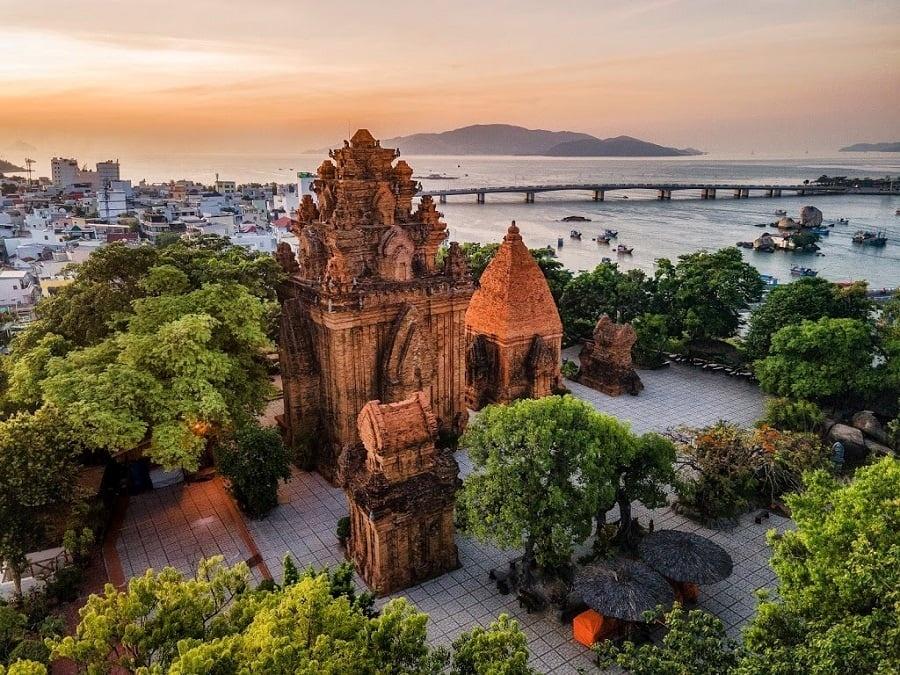
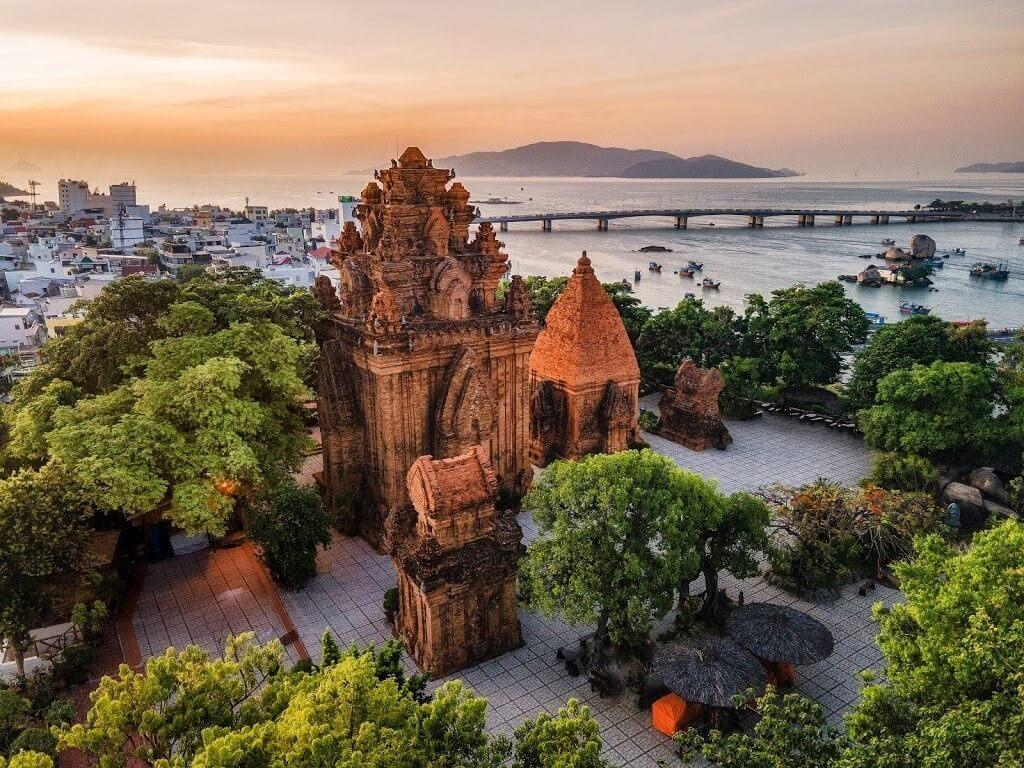
The Po Nagar Cham Towers stand on Cu Lao hill above the mouth of the Cai River, which the Cham called Yatran, the Reed River.
Location
The complex is at 61 Hai Thang Tu Street in Bac Nha Trang Ward, a road also written as 2 Thang 4, on the northern edge of Nha Trang about 2 km from the city centre. Vietnam recognised it as a national architectural and artistic relic in 1979 and ranked it a special national monument in January 2025.
From the hilltop the view runs over the river and out across Nha Trang Bay, with Hon Tre and the outer islands of the bay on the horizon. The ticket counter sits at the foot of the hill. From there the complex rises in three tiers, so expect a short but steep climb.
How to Get There From Nha Trang and the Cam Ranh Peninsula
From Alma Resort Cam Ranh on Bai Dai, the drive is about 45 to 50 minutes, and the airport terminal is about 10 to 15 minutes south of the resort, so a morning flight and an early start combine well. Resort transfer guides put a taxi or Grab to Nha Trang at roughly 375,000 to 550,000 VND (about 14 to 21 USD), so ask for a fixed fare before setting off.
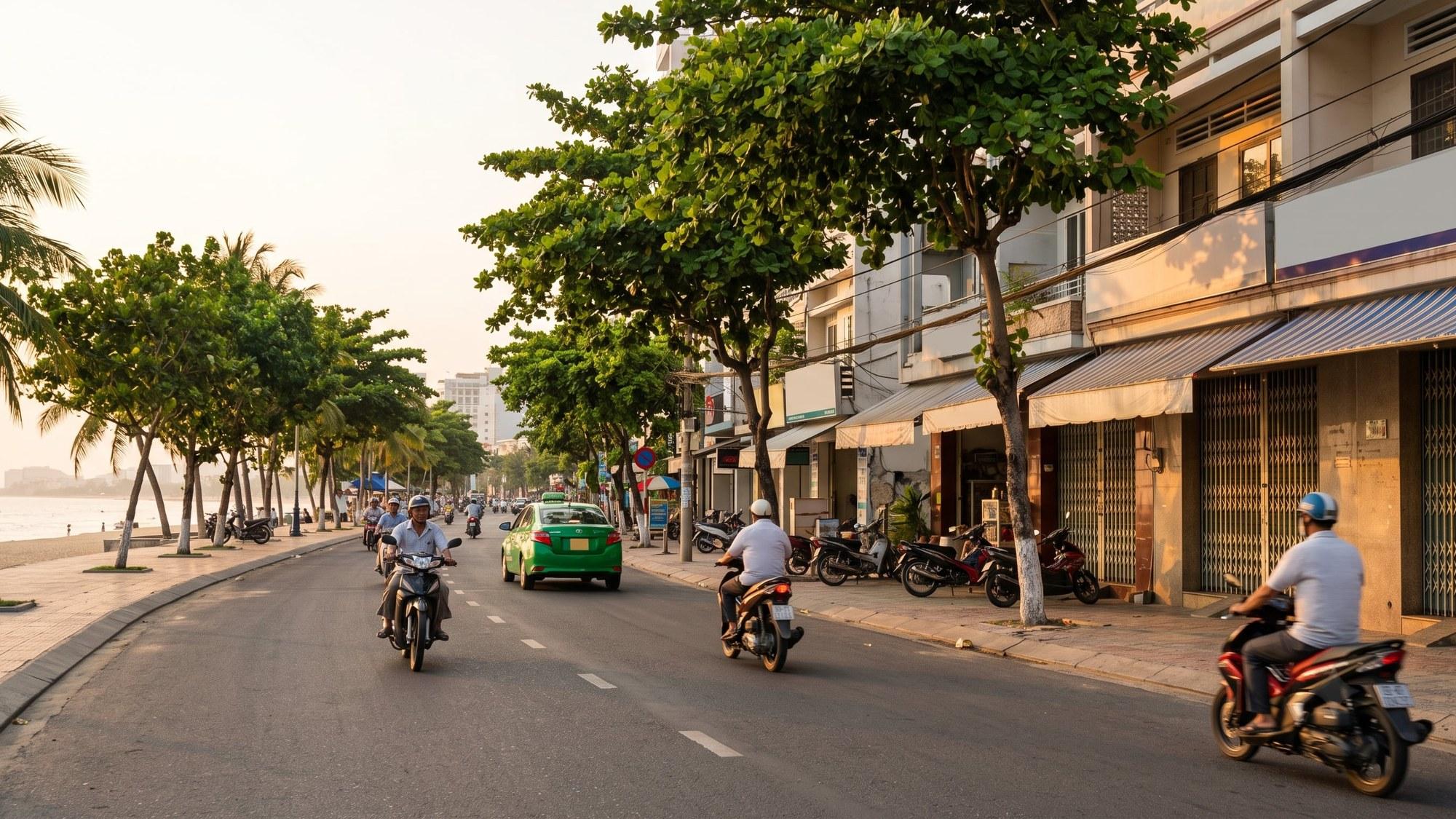
From the centre of Nha Trang, a Grab takes 5 to 10 minutes and costs roughly 30,000 to 50,000 VND (about 1 to 2 USD). Walking takes 20 to 25 minutes north along Tran Phu Street, across Tran Phu Bridge and onto Thap Ba Street. Cars park under the bridge for 30,000 VND and motorbikes for 4,000 VND, and the ticket booth is a short walk from there.
The hop-on hop-off sightseeing bus stops at the towers daily from 08:30 to 16:30, roughly hourly, with a 24-hour pass at 250,000 VND (about 9.50 USD). Drivers waiting at the main gate have a reputation for inflated fares, so book a Grab or agree the price before getting in.
Opening Hours and Ticket Price
From Alma Resort Cam Ranh on Bai Dai, the drive to Po Nagar takes about 45 to 50 minutes. The resort concierge can arrange a private car for the day, making it easy to combine the towers with Long Son Pagoda and Nha Trang Cathedral. For a guided option, Zazen Travel’s Cultural and Heritage Tour includes Po Nagar, Nha Trang Cathedral, Truong Son Craft Village and Dam Market; ask the Promotions Desk about availability, departure times and booking.
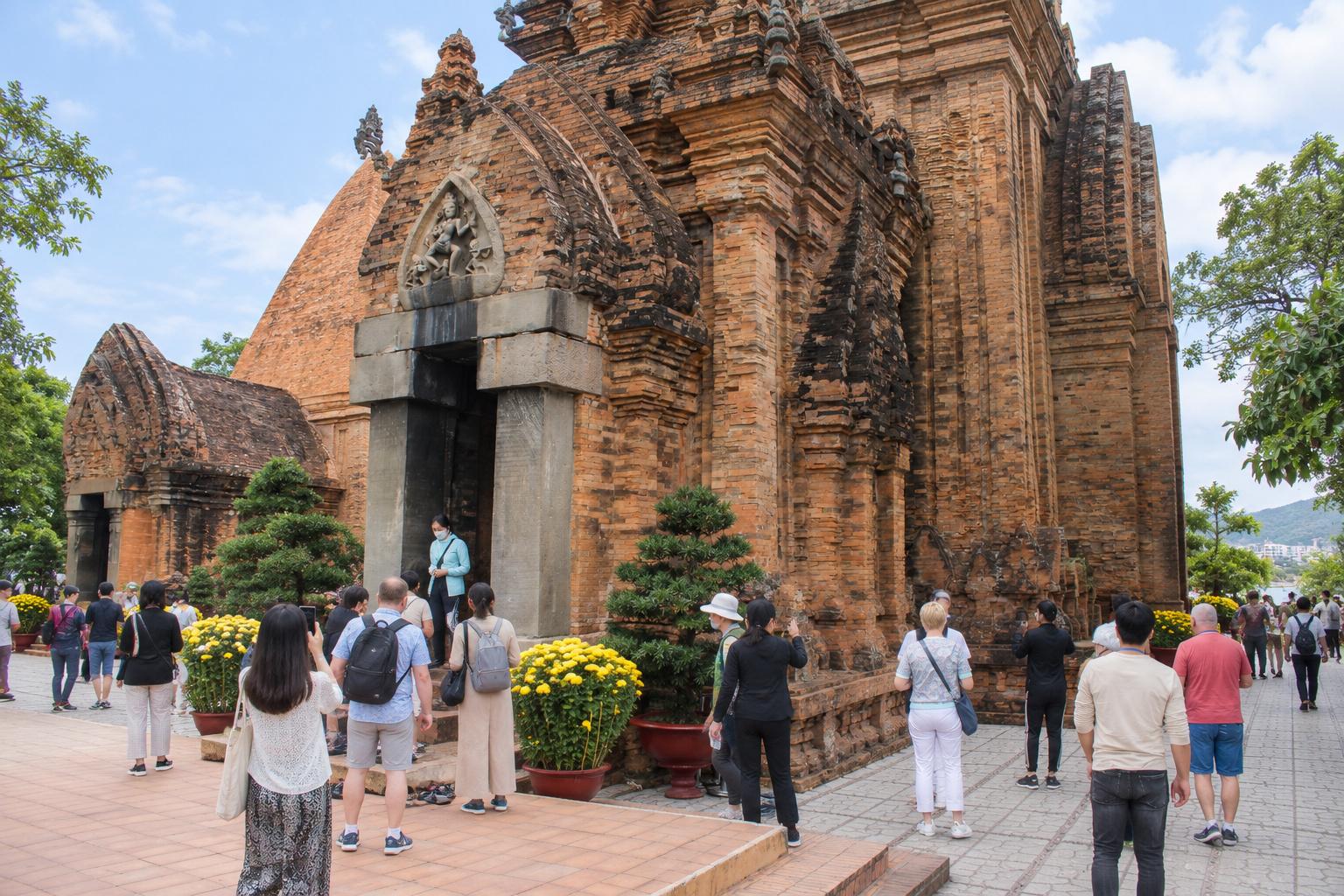
Most visitors spend 30 to 60 minutes on site, and a dance performance adds another 20 to 30 minutes if the timing works.
Detailed Information:
- Address: 61 Hai Thang Tu Street (also written 2 Thang 4), Bac Nha Trang Ward, Nha Trang
- From Alma: About 45 to 50 minutes by car
- Opening Hours: Daily 06:00 to 18:00 (about 17:30 from October to December)
- Entrance Fee: 30,000 VND per person; children free
- Time Needed: 30 to 60 minutes
- Suits: Culture days, early starts and families with older children
History of the Po Nagar Cham Towers
Cham builders raised the brick towers between the 8th and the 13th centuries as a temple to Po Ina Nagar, the Mother of the Land, who the Cham believed rose from clouds and sea foam and taught them to farm and weave. A stele dated to 781 already refers to the temple as existing and damaged, and records that raiders arriving by ship carried off its sacred linga and jewels before being driven out to sea.
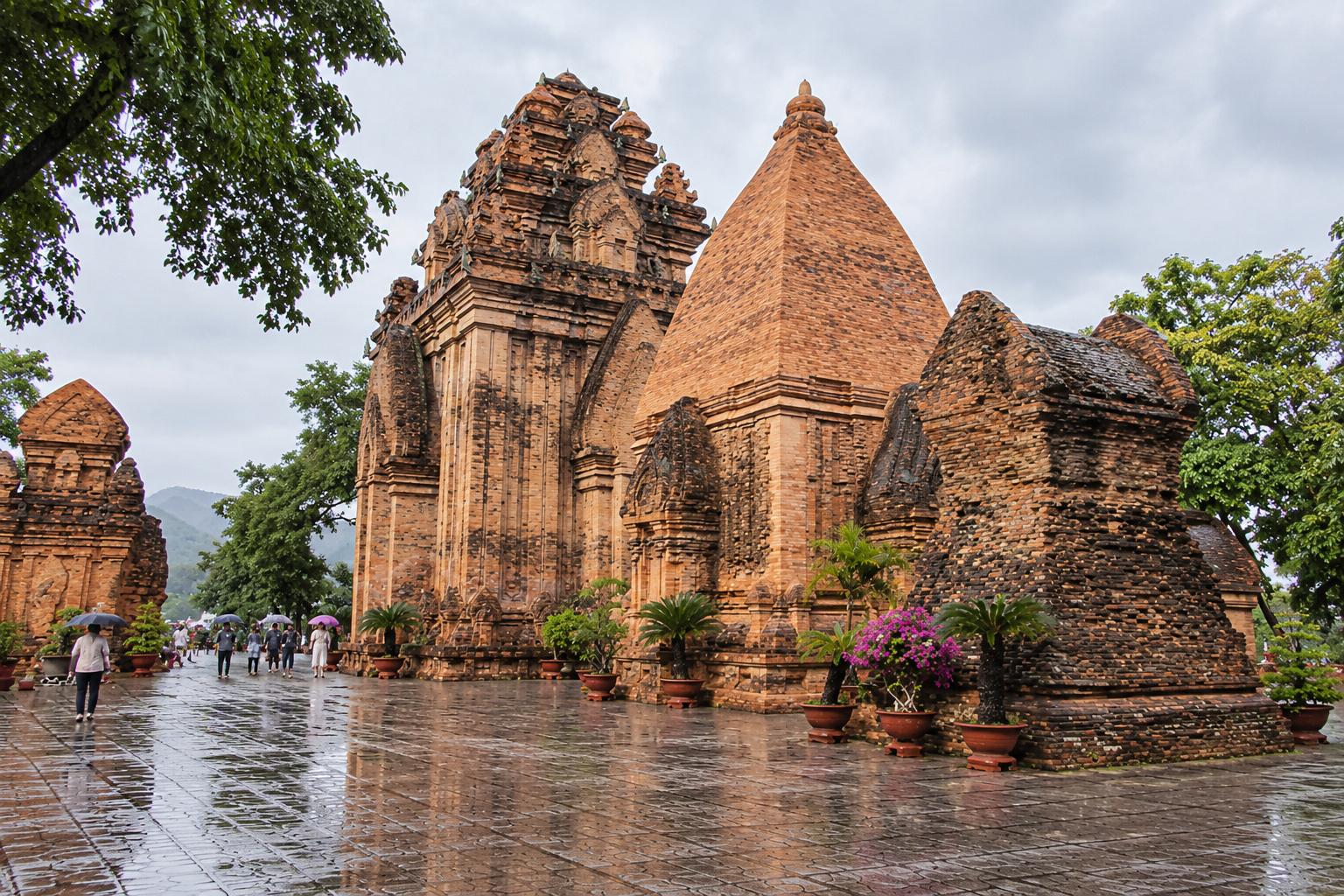
The hill has seen raids and rebuilding across the centuries. In 950 a Khmer king carried off the original gold statue of the goddess, and in 965 a Cham king installed a stone statue in its place. Cham rulers kept endowing the temple with land and treasure through the 11th and 12th centuries, and the main tower was rebuilt and enlarged into the structure that stands today.
When Vietnamese rulers took control of the region in the 17th century, they kept the shrine and adapted the goddess into Thien Y A Na Thanh Mau, a mother figure in Vietnamese folk belief. The site therefore serves two communities, and Cham and Kinh worshippers still bring offerings to the same altars.
Six towers once stood on the hill, and four survive. The most recent major restoration ran from 2000 to 2003, so what visitors see is weathered brick with later repairs. The spellings Ponagar, Po Nagar and Pô Nagar name the same temple, whose Cham name is usually translated as Lady of the Kingdom, and Vietnamese visitors call it Thap Ba, the Lady’s Tower.
The Legend of the Holy Mother
Two stories share the hill. The Cham honour Po Ina Nagar, who rose from the sea and taught people to plant rice and weave cloth. The Vietnamese honour Thien Y A Na, and in the telling most guides repeat, an old couple on Dai An mountain found a girl among their melon vines and raised her as their own.
The girl grew up generous and wise, and she taught the villagers to farm. One day she stepped onto a log of fragrant aloeswood and drifted across the water to the Cham coast, where a prince married her. After her death people worshipped her as the Holy Mother who protects the land, the crops and the sea.
Versions differ from village to village, but the shape stays the same, and it explains why Vietnamese pilgrims light incense at a Cham temple. A Khanh Hoa tourism article on Am Chua Dien Khanh, a quieter pilgrimage site on Dai An mountain, describes it as a place of worship for the same Holy Mother and suggests visiting it to understand where her cult began.
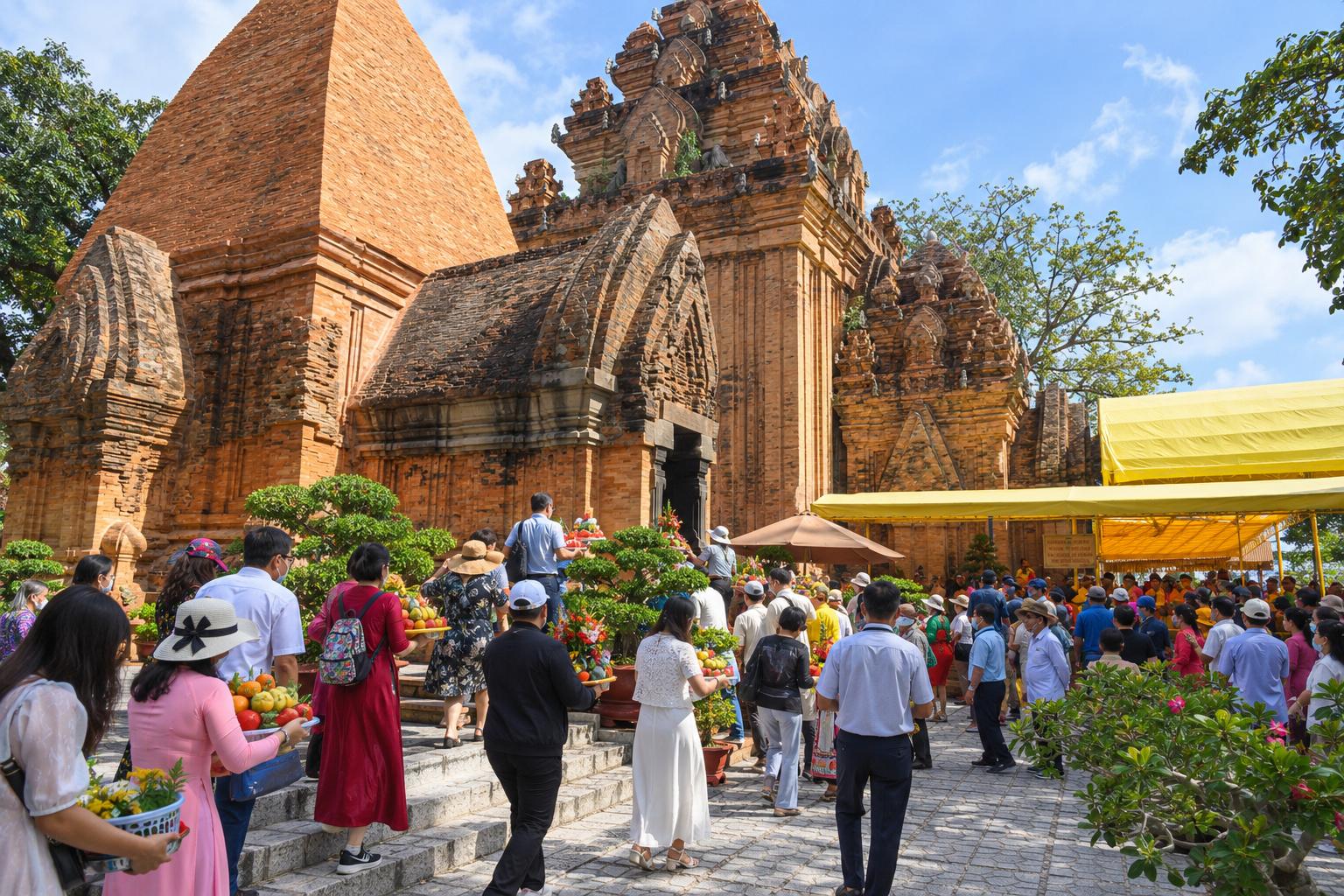
The legend also explains what is on the altars. Fruit, flowers and incense are offerings to the Holy Mother, and the Robe Changing Ceremony of the festival dresses her statue in new clothes.
What to See at the Po Nagar Cham Towers
The complex climbs the hill in three stages, from the ruined gate to the Mandapa and on to the four towers at the top.
The Gate Tower
The gate tower marks the original entrance at the foot of the hill. It once had a pointed roof in the Cham style, but little remains beyond its foundation stones and a steep brick staircase. Worshippers once bowed while climbing and walked backwards while descending, so they never turned their backs on the goddess.
The Mandapa
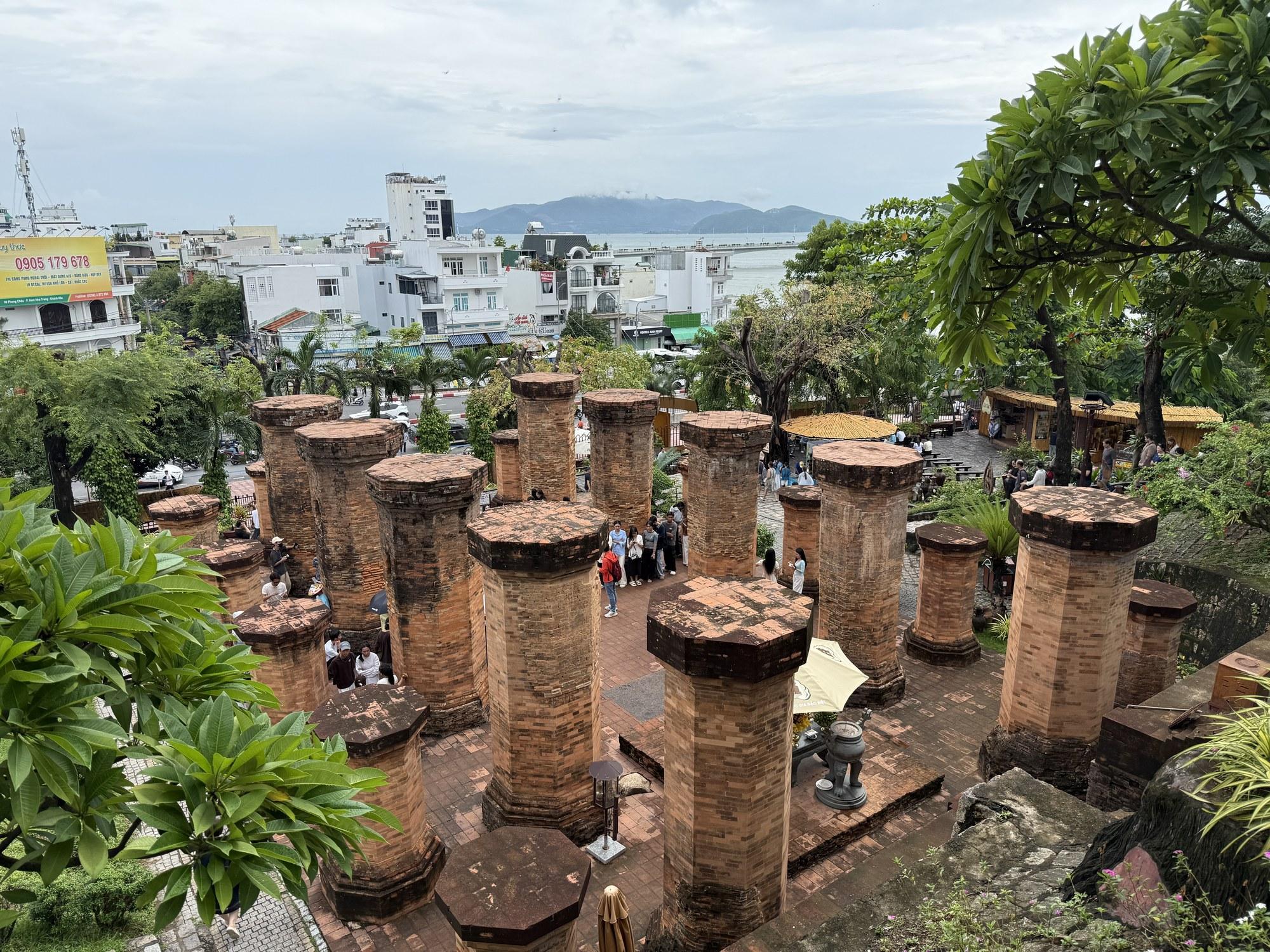
The Mandapa is the open hall where devotees prepared their offerings before entering the temple. The provincial Cham heritage page counts four rows of octagonal brick pillars, ten large and twelve small, and says they once carried the roof of the hall. The roof is gone but the pillars stand in their original order, so the layout is easy to read. From here, a steep flight of brick steps leads up to the tower terrace.
The Main Tower and Its Three Shrines
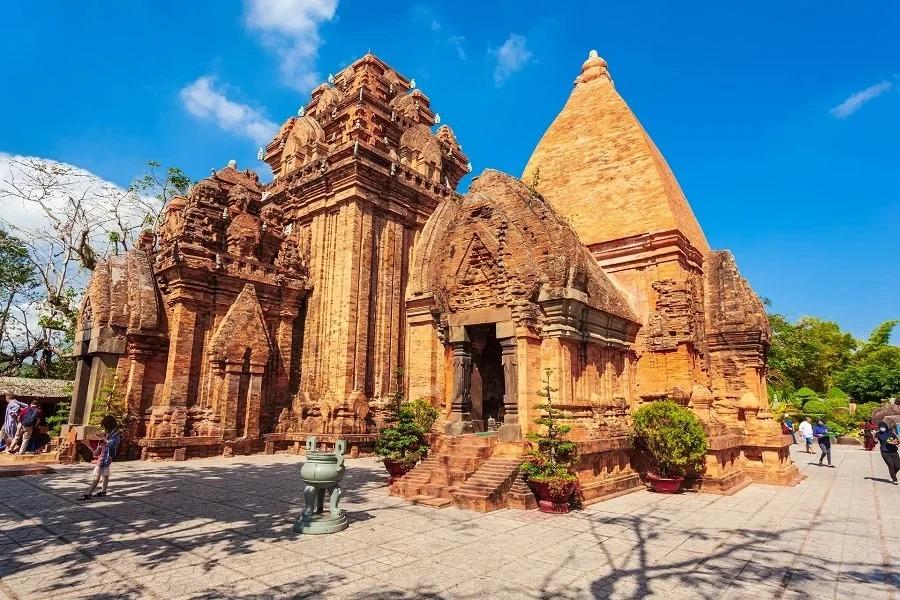
The towers on the upper terrace are built of reddish-pink porous brick laid without mortar. Nobody is sure how the bricks were bonded. One theory points to resin from the boi loi tree. Whatever the method, the towers have stood for more than a thousand years. The main tower rises about 23 metres in a base, a body and a three-tiered roof, and only the east doorway is real; the other three are false doors.
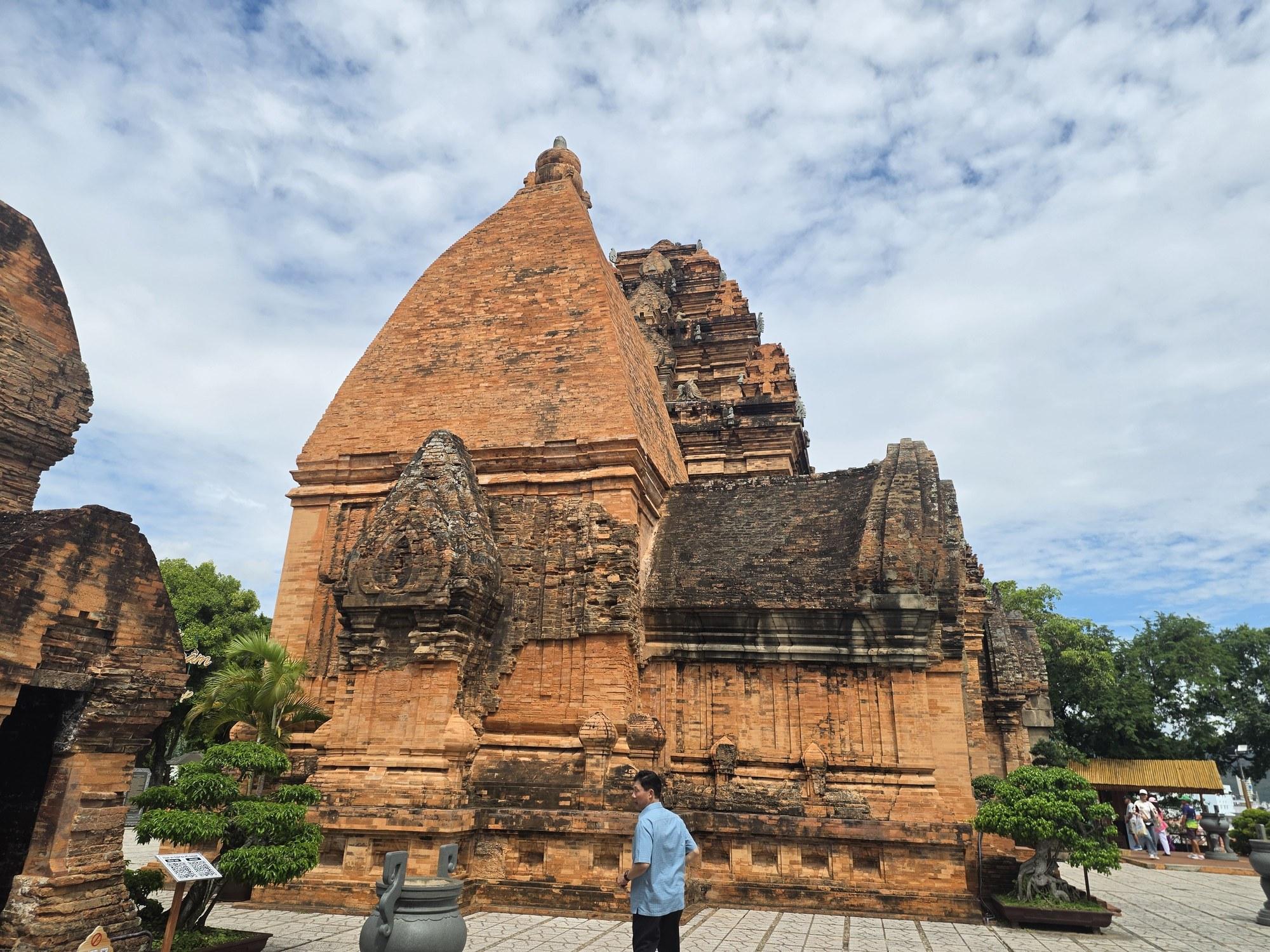
Inside, a black granite statue of Po Ina Nagar about 2.6 metres tall sits cross-legged on a lotus pedestal, with her back against a bodhi-leaf-shaped slab. A carved lintel above the doorway shows a dancing deity between two musicians.
Three smaller towers stand beside it: the south tower, dedicated to Cri Cambhu, a form of Shiva, the south-east tower with a boat-shaped roof honouring Sandaka, and the north-west tower with a saddle-shaped roof dedicated to Ganesha. Terracotta reliefs of gods, animals and celestial figures cover their walls.
Steles and Inscriptions
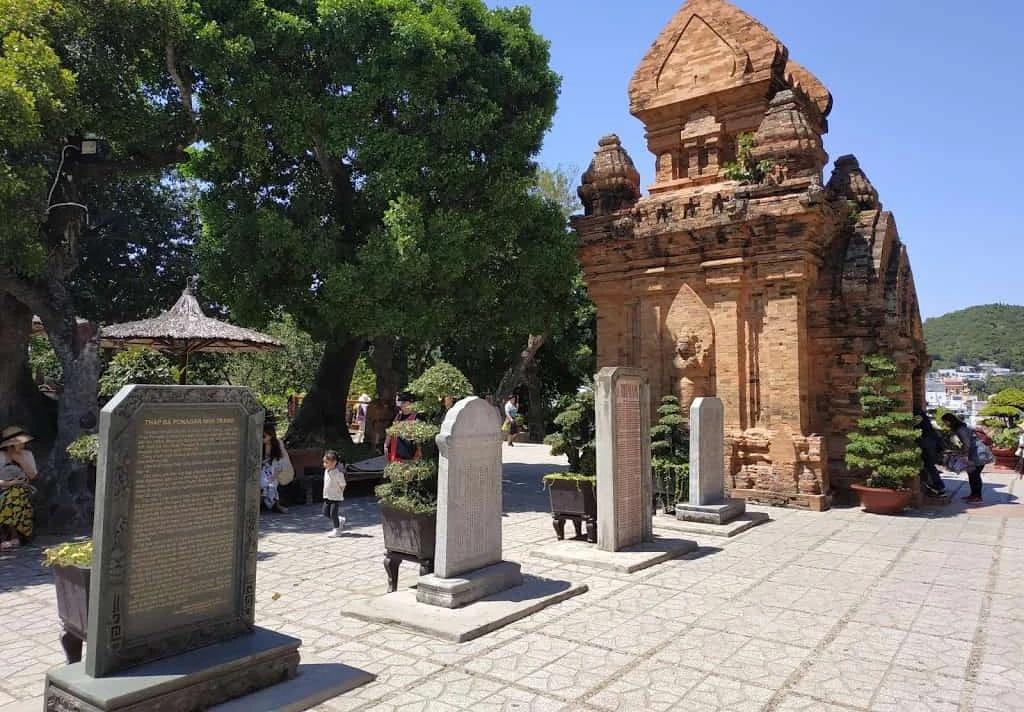
Inscribed stones in Sanskrit and Cham record the temple’s founding, its raids and its restorations. Behind the main tower stands a stele engraved in 1856 by the mandarin Phan Thanh Gian that tells the Vietnamese legend of the Holy Mother, and a stele erected in 2010 introduces the monument in Vietnamese. QR codes at the tower clusters link to an audio guide.
A small exhibition room holds a full-size replica of the goddess, reproductions of royal decrees and historical photographs, which show the carved details that the dressed statue in the main tower hides.
Things to Do at the Po Nagar Cham Towers
Time your visit right and there’s more to Po Nagar than a quick walk round.
Join the Po Nagar Festival
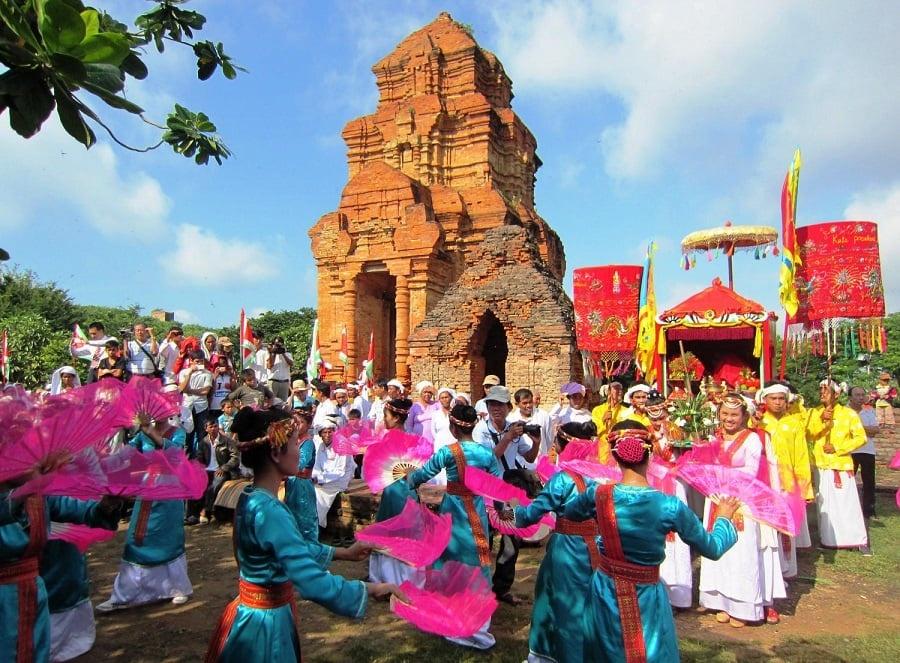
The Po Nagar Festival takes place each year from the 20th to the 23rd day of the third lunar month, with a Robe Changing Ceremony, a Floating Lantern Ceremony, offerings and folk performances. Gregorian dates change each year: in 2027 the 20th to 23rd of the third lunar month falls on 26 to 29 April, and the 2026 celebrations ran from 5 to 11 May, so the programme can last longer than the four core days.
The guide to festivals in Cam Ranh and Nha Trang lists the other dates that shape a trip, and modest dress is expected during the festival, as on any other day.
Watch Cham Dance and Music
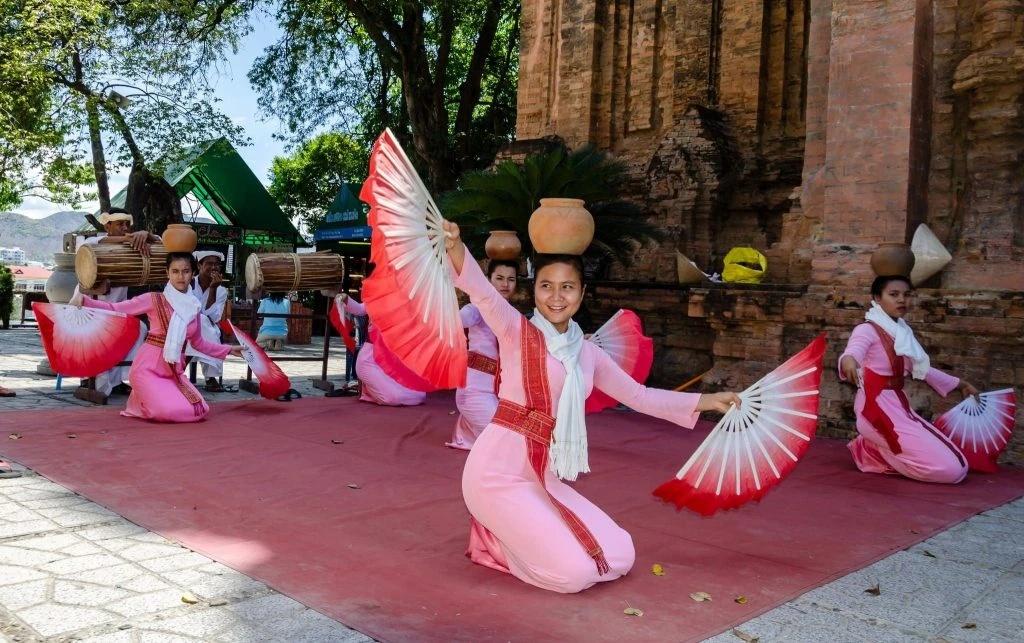
Traditional Cham dances are performed at the complex, with dancers in full Cham dress moving to live music on the Ginang drum, the Kanhi fiddle and the Saranai flute. Schedules vary, so ask at the ticket counter on arrival whether a performance is due, and wait for the next one if one has just ended. Give the dancers room and keep voices low.
Shop for Cham Handicrafts
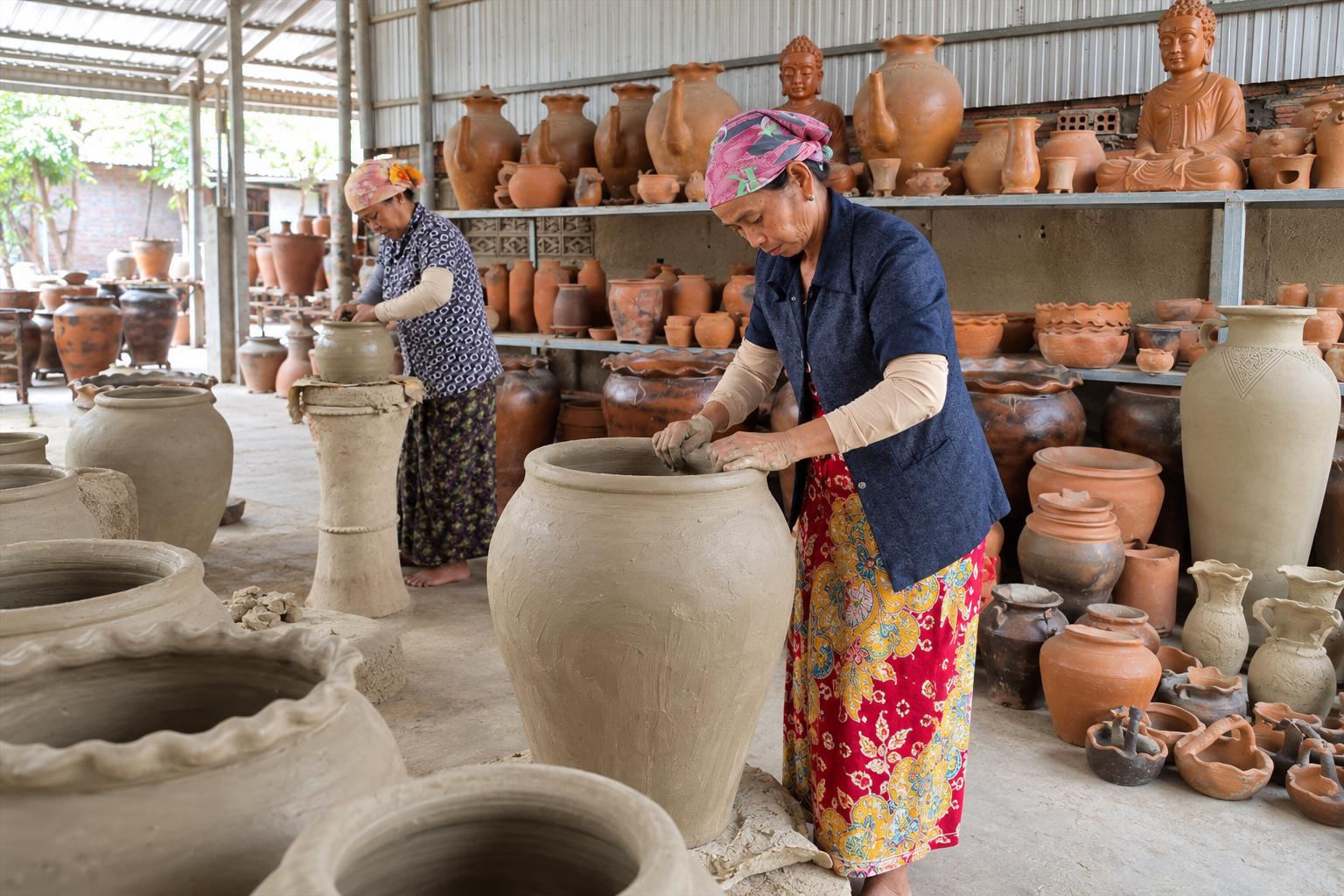
A souvenir area near the exit sells Cham-patterned scarves, ceramic figurines, woven bags and miniature tower replicas, and some are made by Cham artisans. Quality and prices vary, and most sellers prefer cash in small notes.
Seasons, Heat and Festival Crowds
The dry season runs from January to August, bringing clear skies over the bay and the best light on the brickwork. From September the rain returns, with the heaviest falls in October and November, so the steps and the terrace can be slippery; wear sandals with grip that slip off easily at each tower.
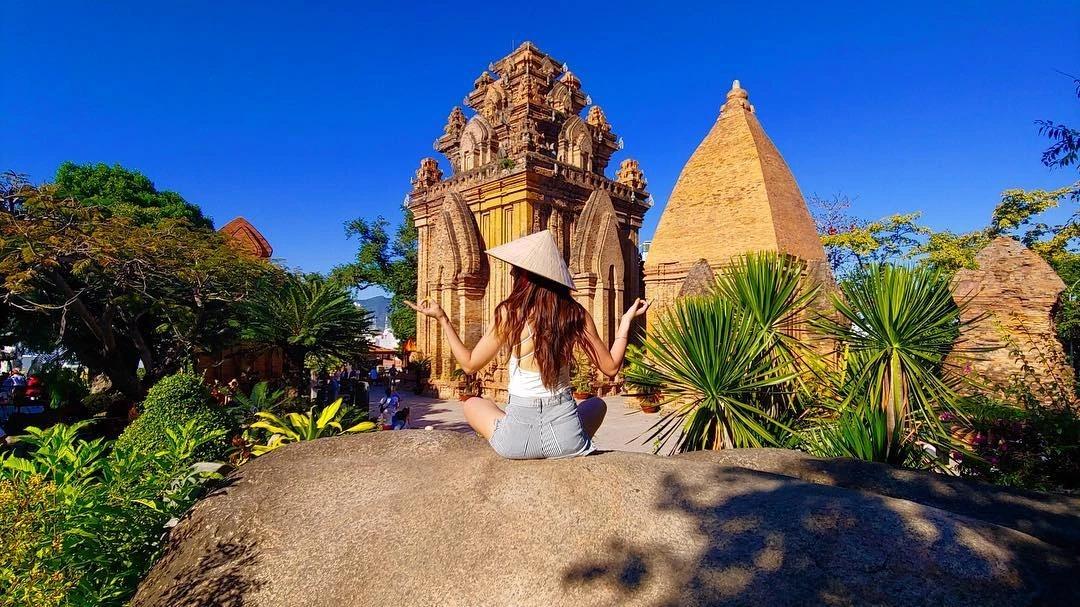
Heat is the other limit. The upper terrace has little shade, and from April to August the sun on bare brick is strong from late morning, so carry water and a hat, and plan the climb before 09:00 or in the last hour of the afternoon.
The Po Nagar Festival is held in the third lunar month, and Tet is another period when local families visit the site. Check the current festival programme and opening information before planning around either date. The guide to Tet in Cam Ranh and Nha Trang covers the new year period.
Is Po Nagar Worth the Visit?
For most visitors it is, as a short stop rather than a full day. Reviewers praise the setting on the hill, the view over the river mouth and the calm around the towers, and in our experience the main complaint is thin English signage, not the site itself.
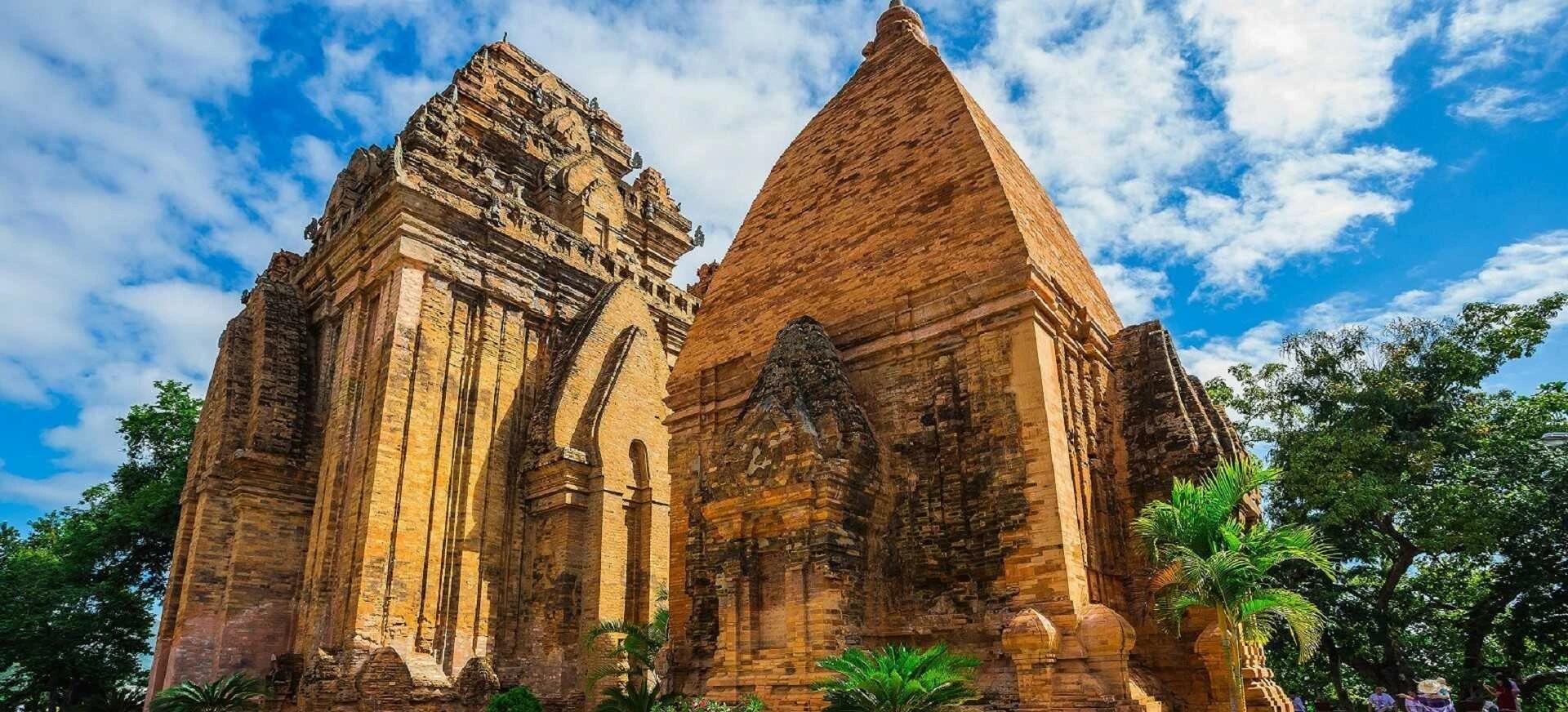
Allow 30 to 60 minutes inside, or about an hour and a half with the climb, the exhibition room and the souvenir stalls. The visit suits anyone curious about Cham history, photographers who like weathered brick and travellers who want one cultural stop between beach days. It’s less rewarding if you’re expecting a sprawling complex (the site is compact) or if steep steps are a problem.
Add a second stop and you have a half-day. Long Son Pagoda and the Stone Church lie a short ride away, and the sightseeing bus links the main sights of the city, as the section on nearby attractions sets out.
How Po Nagar Compares With Other Cham Sites
Unlike most Cham sites, Po Nagar is still a working temple, and that separates it from the better-known ruins. My Son, about an hour from Hoi An (now in Da Nang city), is a UNESCO World Heritage site with a larger group of ruined towers in a forest valley, and it is mostly a place to look at rather than pray in.
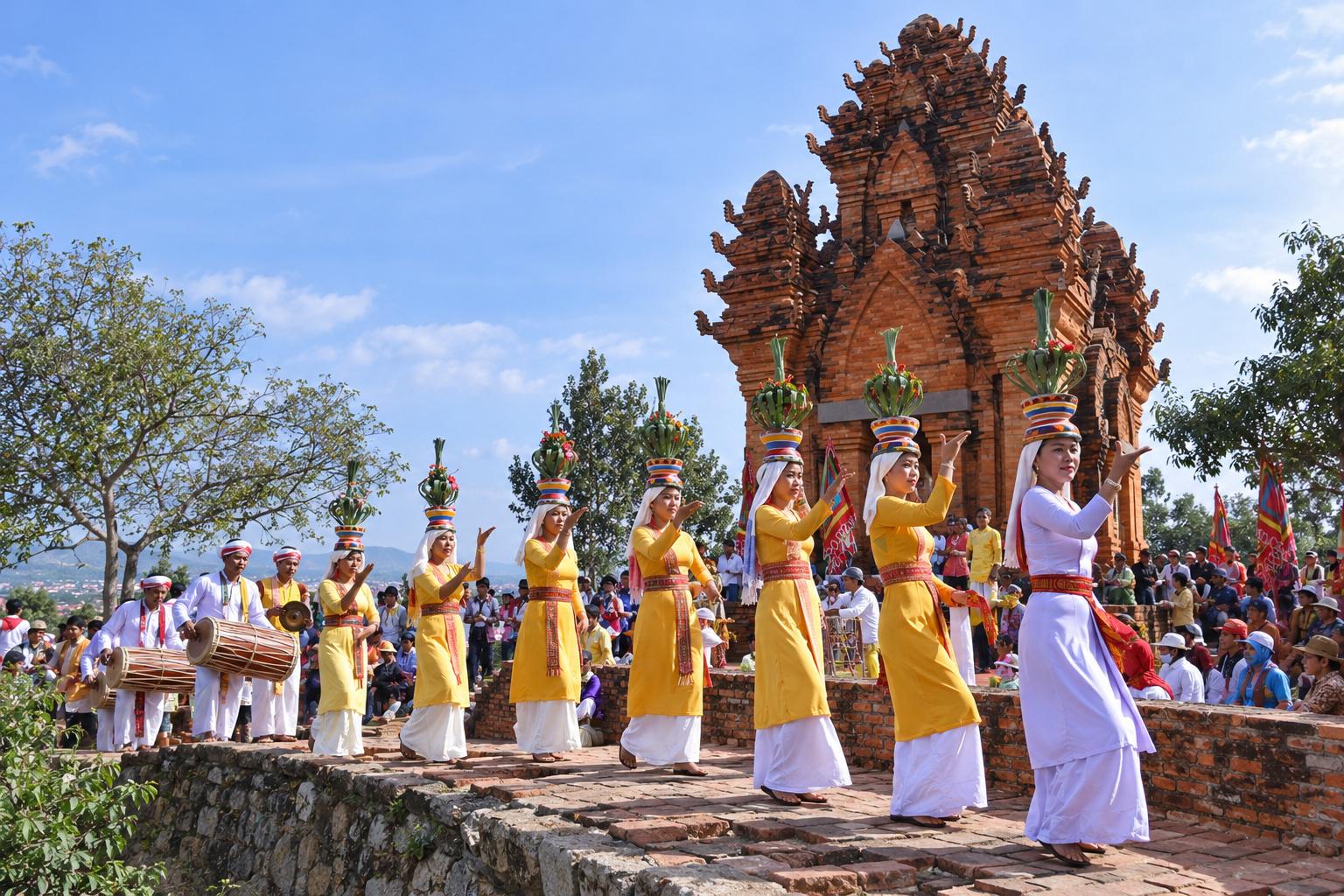
Po Klong Garai, in Phan Rang (now part of Khanh Hoa province), is a single group of brick towers from the late 13th century, and it also stays in use for the Katé festival.
Because Po Nagar sits right in the city, an hour is enough. It’s also still a working shrine with daily offerings, which is why the dress code and shoes-off rule apply.
Dress Code and Insider Tips
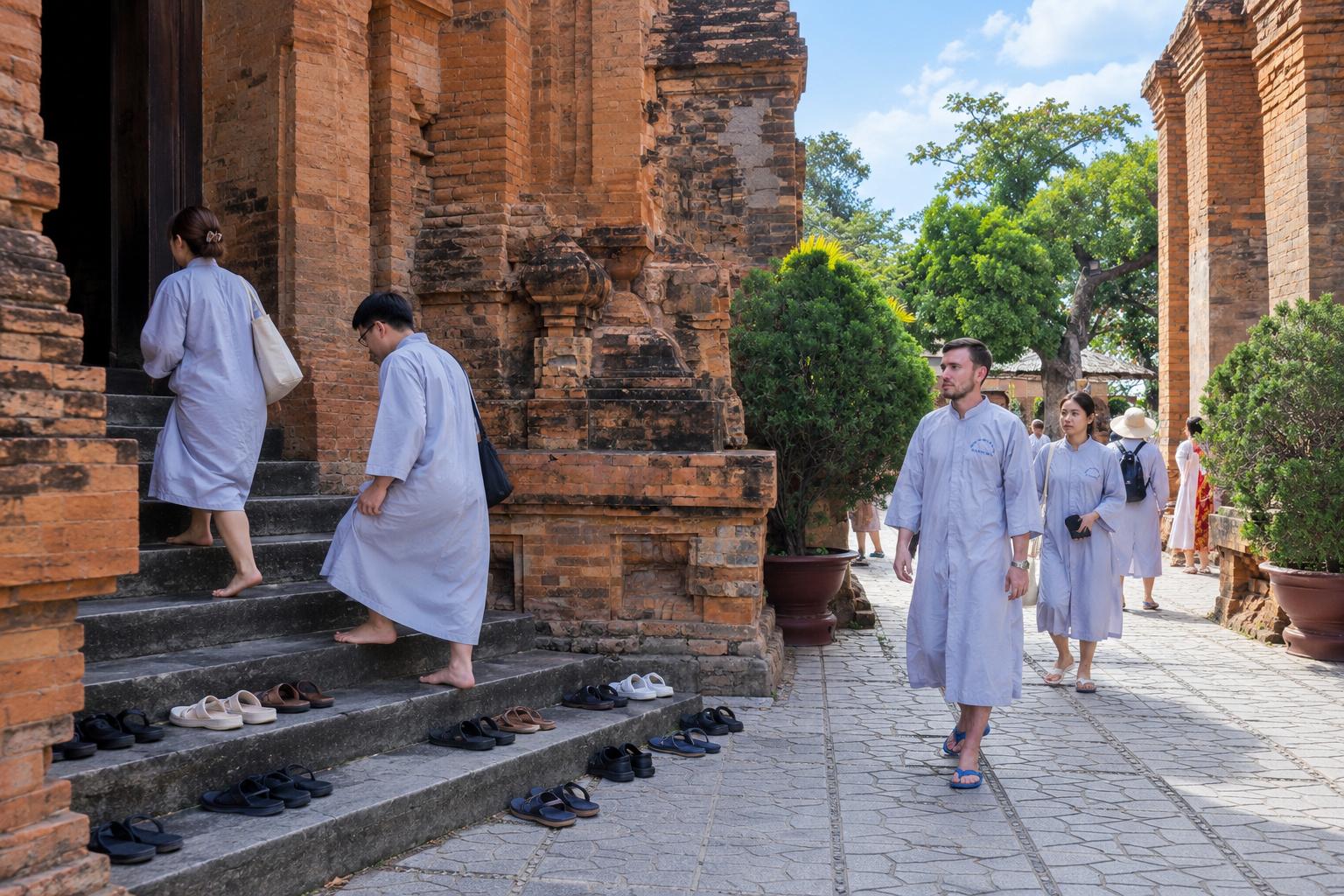
Po Nagar is a working temple, so shoulders and knees must be covered to enter the towers, and shoes come off before each one. Visitors in shorts or sleeveless tops are offered free loaner tops (áo lam) at the entrance, though a personal sarong or light shawl is the better choice on a hot day, and hats and sunglasses come off inside the shrines.
- Visit in the morning or later in the afternoon for softer light and cooler air.
- Expect a steep flight of steps and little shade on the upper terrace, so wear shoes that slip off easily and bring water; the climb is not suited to anyone who cannot manage stairs.
- For the classic shot, stand at the foot of the main tower and shoot upwards, and note that the brick turns from deep red on overcast days to warm orange in direct sun.
- Clean toilets, drink stalls, snack bars and shaded seating are available near the main temple area.
- In heavy rain, skip the climb and spend the hour in the exhibition room, or move on to the hot springs nearby.
- Several seafood restaurants operate near the hill. Check current menus and prices before choosing one.
Nearby Attractions
| Place | Distance from Po Nagar | Highlights | Cost |
|---|---|---|---|
| Thap Ba Hot Spring Center | About 1.5 km | Mud baths, mineral pools and herbal soaks | Rates vary; confirm with the operator. |
| Tu Ton Pagoda on Hon Do Island | About 3.9 km | A free boat ride to a quiet island pagoda | Free |
| Long Son Pagoda | About 4 km, 9 minutes by car | The White Buddha and the hillside temple | Free |
| Nha Trang Stone Church | 7 minutes by car | Gothic cathedral on a hill | Free |
Long Son Pagoda and the church make the easiest second and third stops, and the guide to Long Son Pagoda and the Stone Church sets out the route between them. Anyone planning a longer trip can build it from the Nha Trang itinerary, the Nha Trang travel guide and the wider things to do in Nha Trang.
Where to Stay for a Cultural Day Out
Base yourself on the Cam Ranh peninsula and the temple becomes a morning out, not the whole holiday. The towers reward an early start, and the afternoon is better spent in the water than on the road.
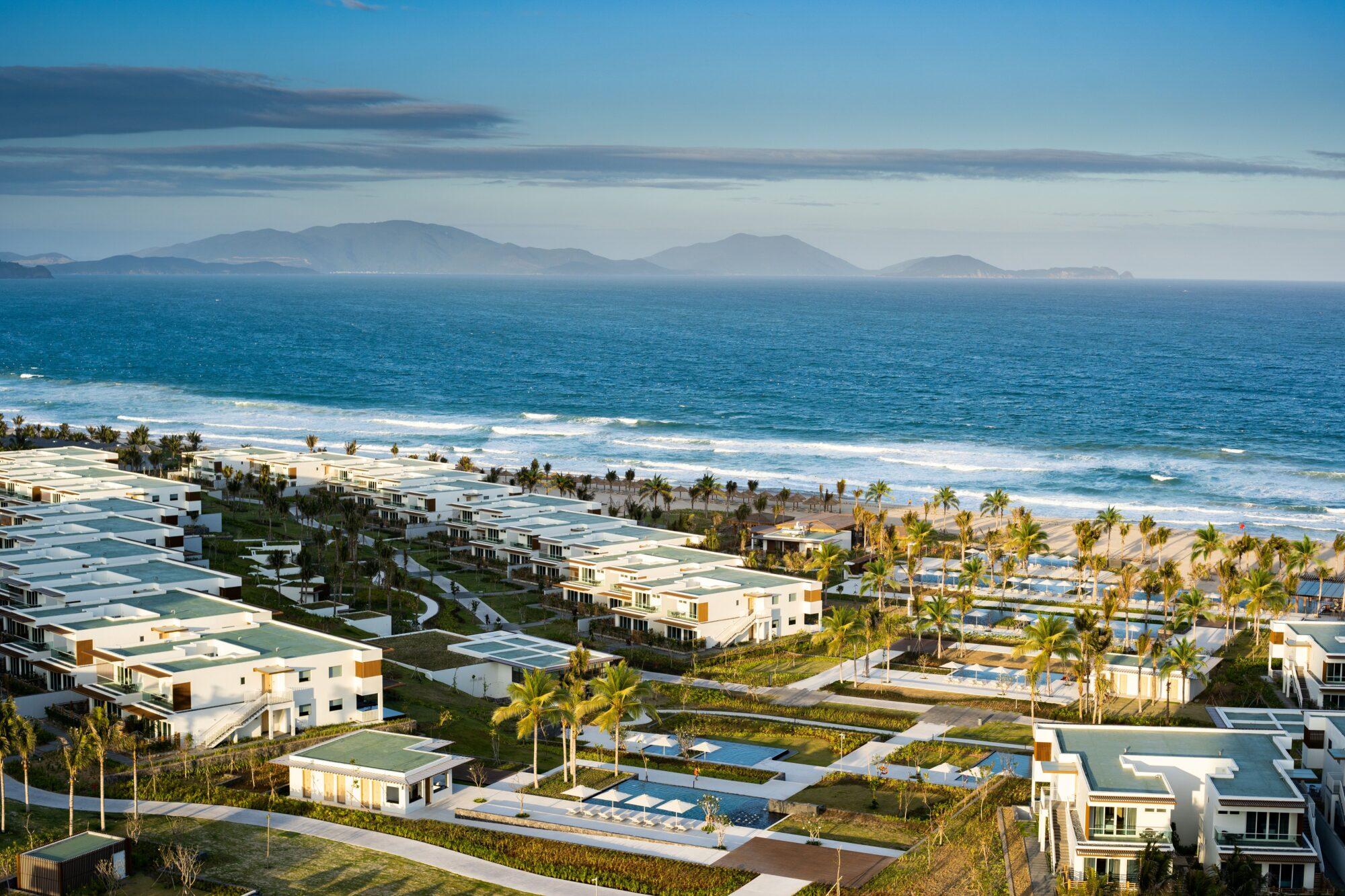
Alma Resort Cam Ranh sits about 10 to 15 minutes from Cam Ranh International Airport. Leave at 07:30 and you’ll be on the hill while it’s still cool, and back for a late lunch by the pool.
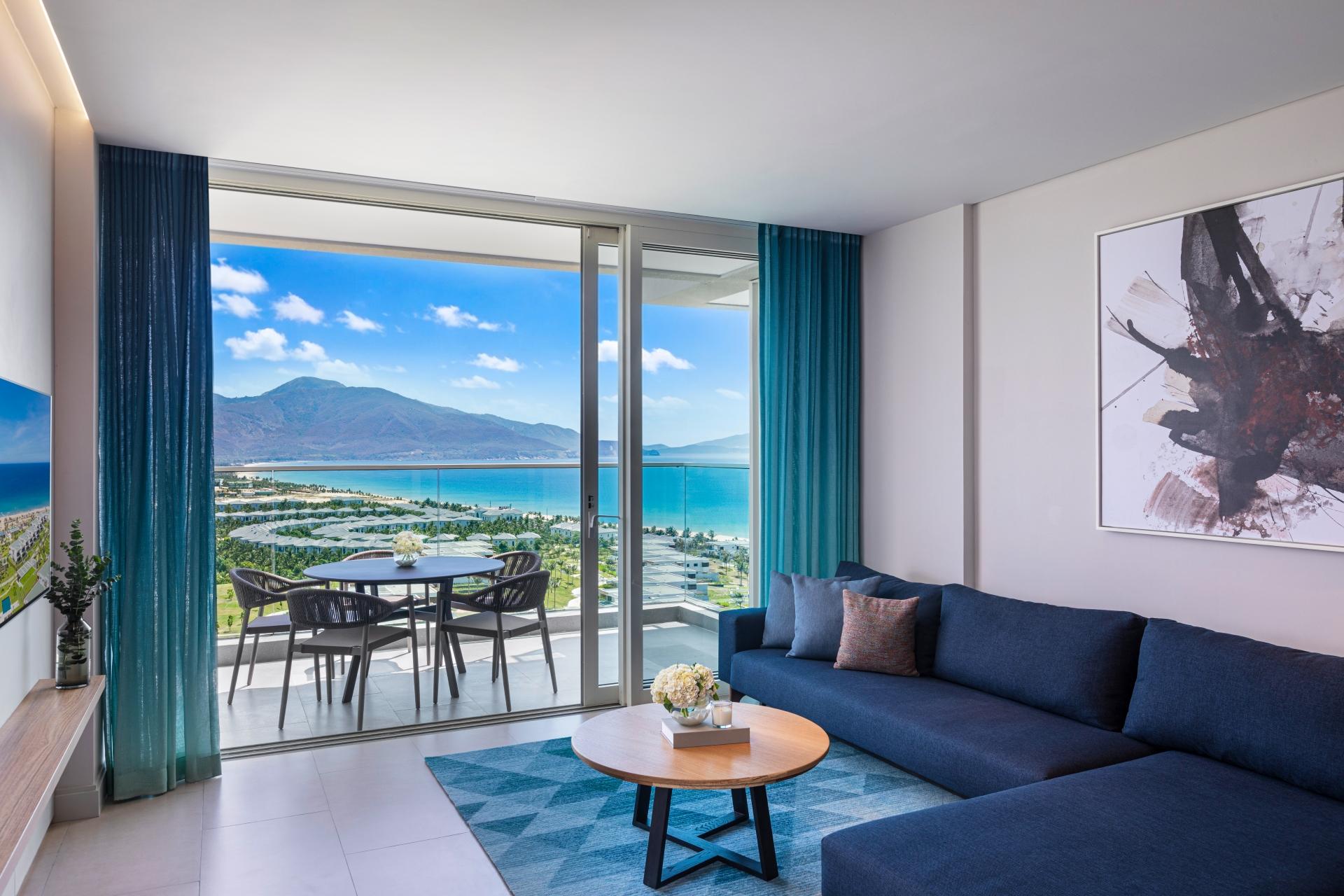
For a couple on a culture trip, the 1 Bedroom Suite with Terrace Ocean View measures 70 sqm. It has an ocean-facing terrace, a bathroom with a bath and a rain shower, and a tea and coffee corner with a mini pantry (non-cooking); the terrace is the perfect spot to scroll through the morning’s photos.
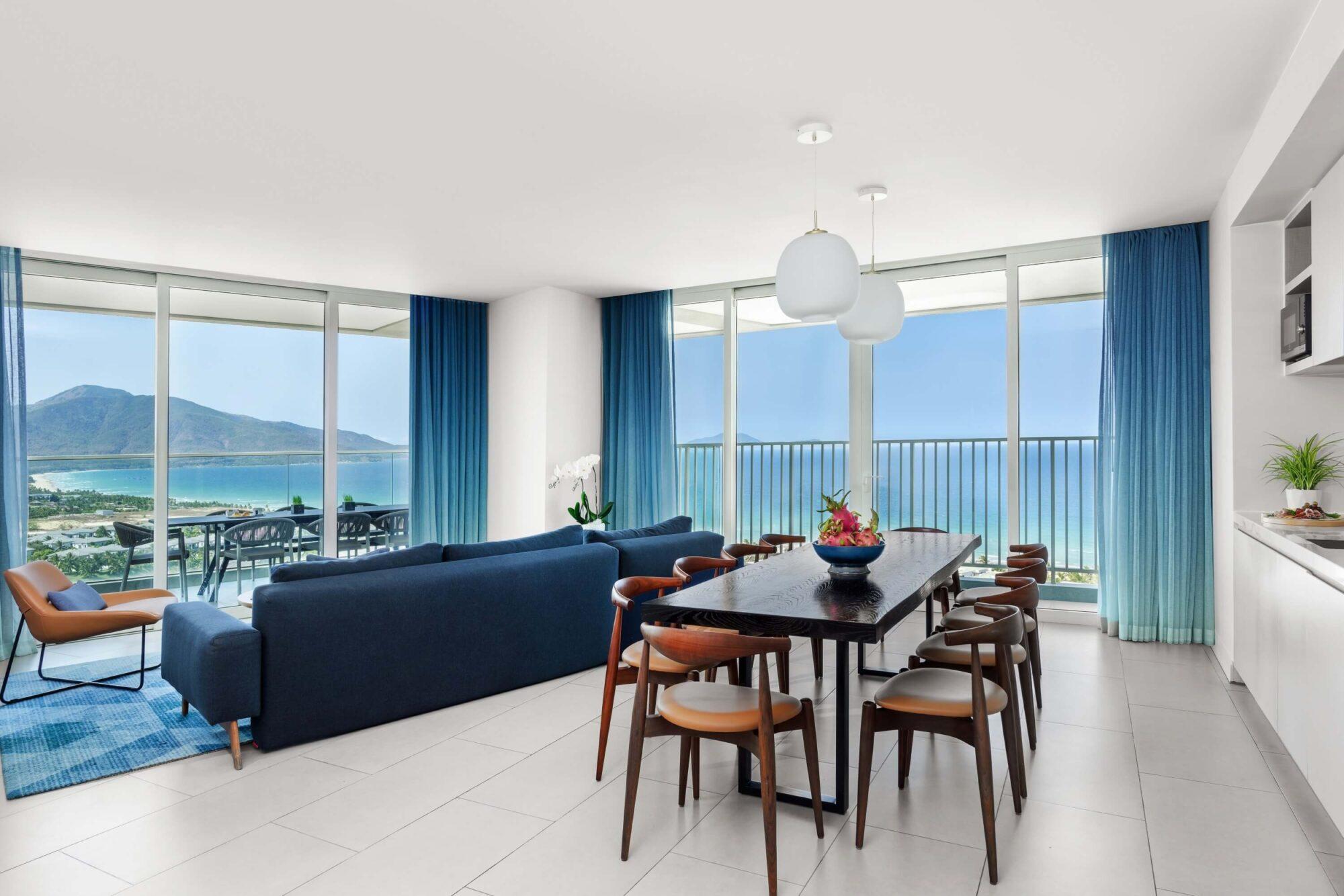
The 3 Bedroom Suite with Terrace, Panoramic Ocean View spans 165 sqm. Each bedroom has its own en suite with a rain shower, a private terrace opens to the East Sea, and a non-cooking pantry with a tea and coffee corner sits inside the suite.
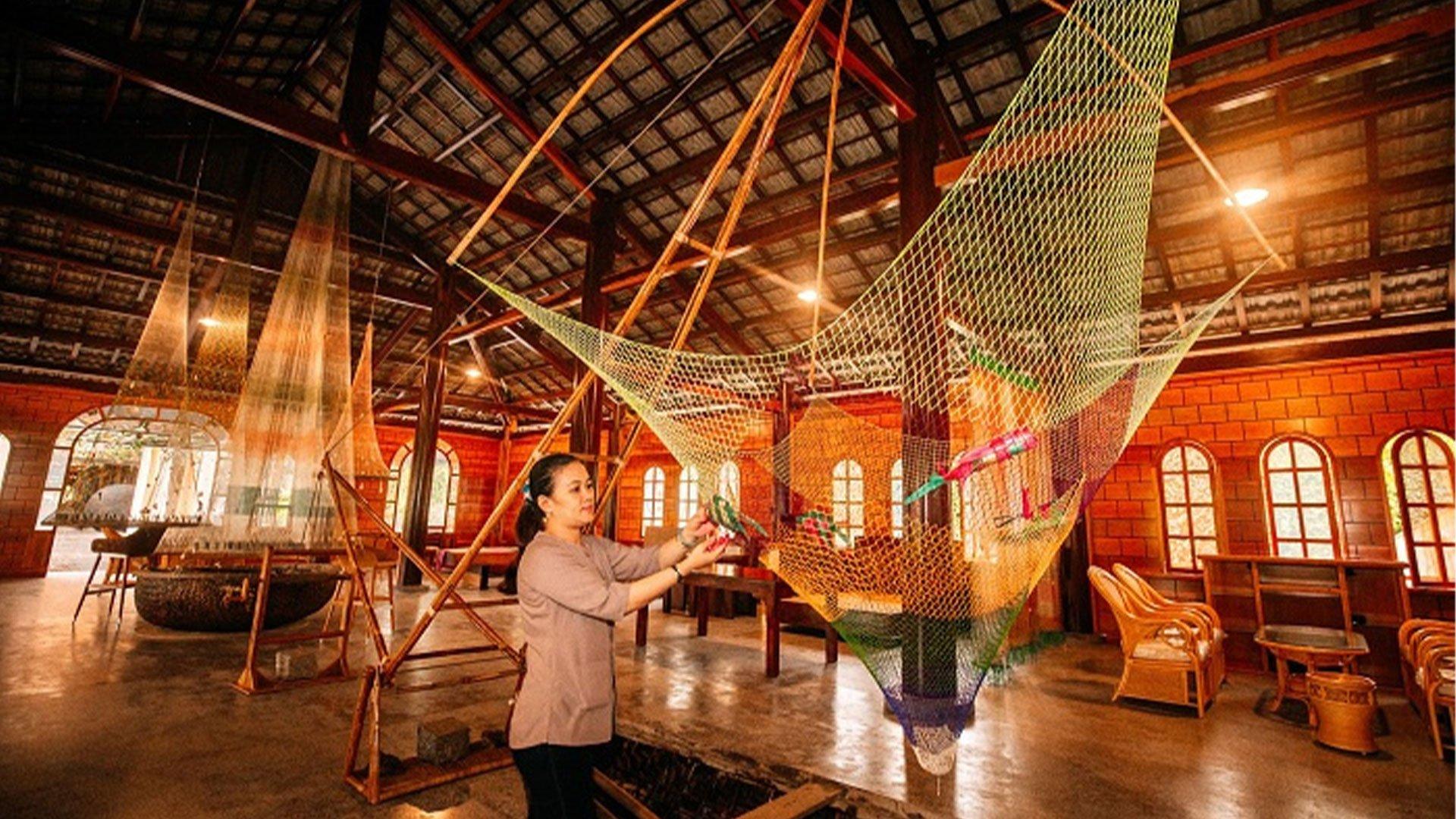
If you prefer a guided itinerary rather than a private car, the Zazen Travel tour described above can be booked through the Promotions Desk. Confirm its current price and departure time.
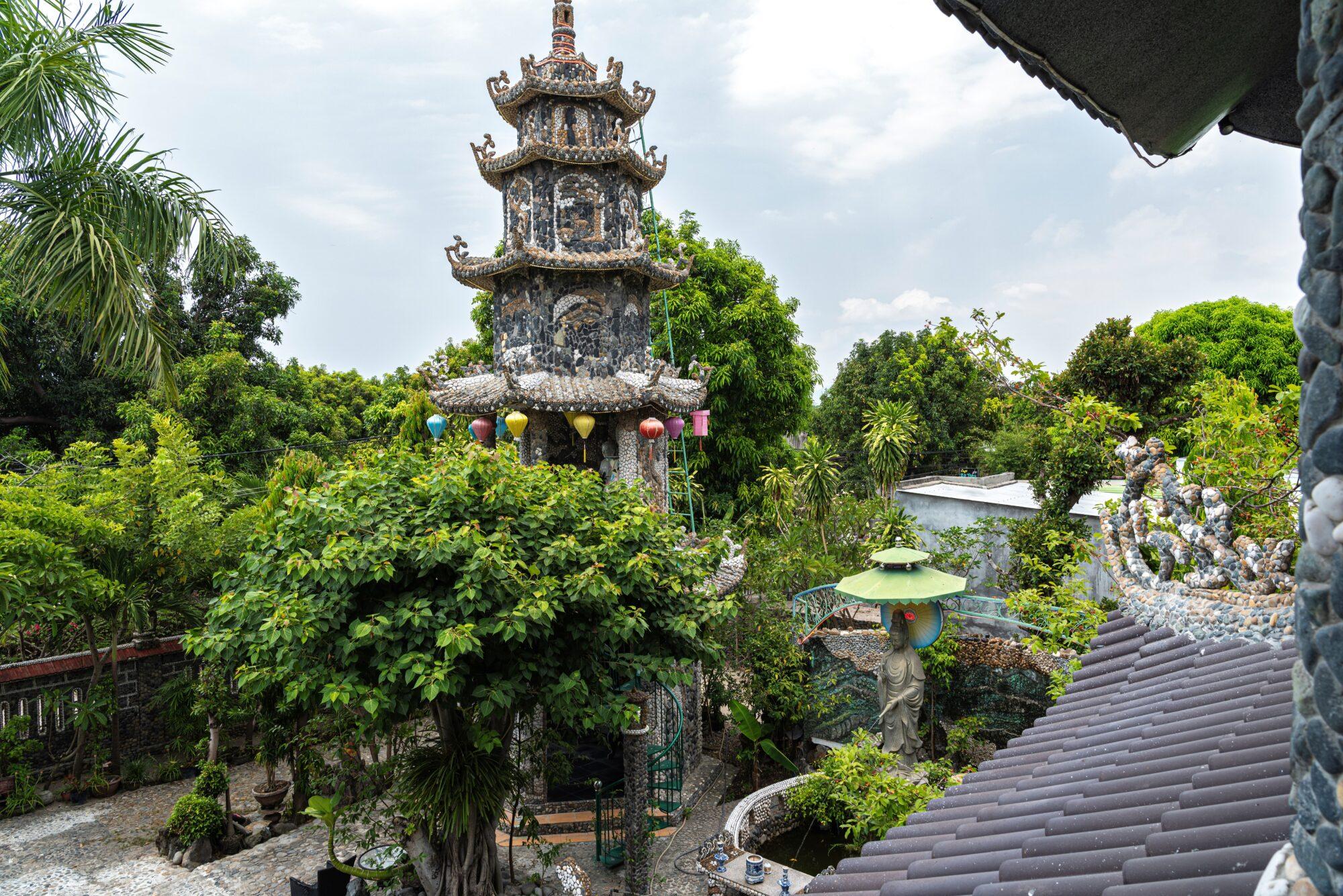
English signage is thin, so it’s worth hiring a guide at the gate. For a shorter outing on the peninsula itself, Tu Van Pagoda, the shell-clad temple in Cam Ranh city, makes a second cultural morning, and the guide on how to get around Cam Ranh covers taxis, Grab and rentals.
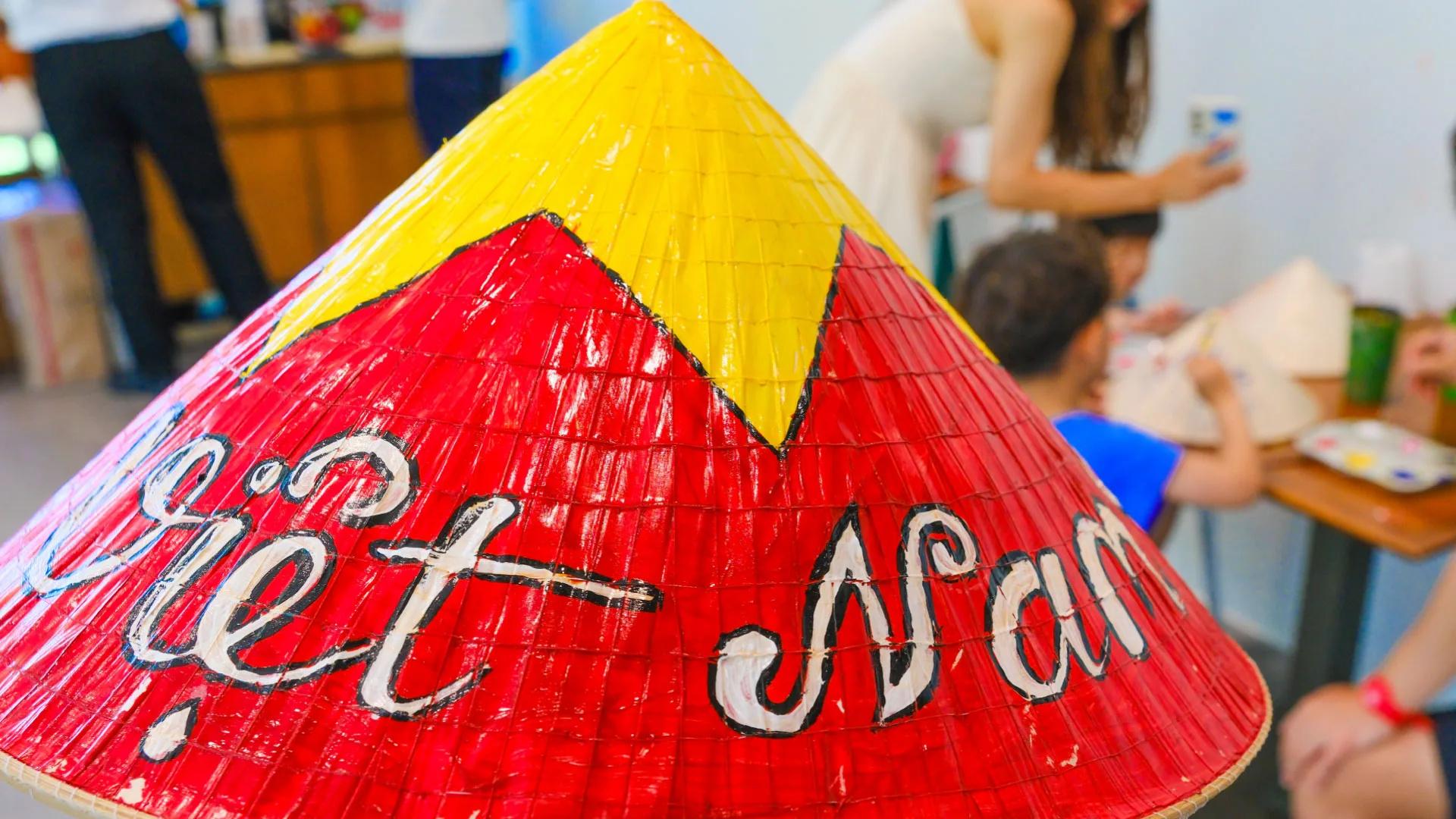
Back at the resort, the Creative Workshops run daily from 10:00 to 16:00 at the Handicraft Workshop, and a morning among Cham towers pairs well with something to make by hand. Conical Hat Painting costs 200,000 VND for a large hat and 150,000 VND for a small one (about 8 and 6 USD), Claypot Painting 150,000 VND, and Wood Carving, Candle Making and Lantern Making between 400,000 and 450,000 VND. Prices can change, so confirm them at the Promotions Desk.
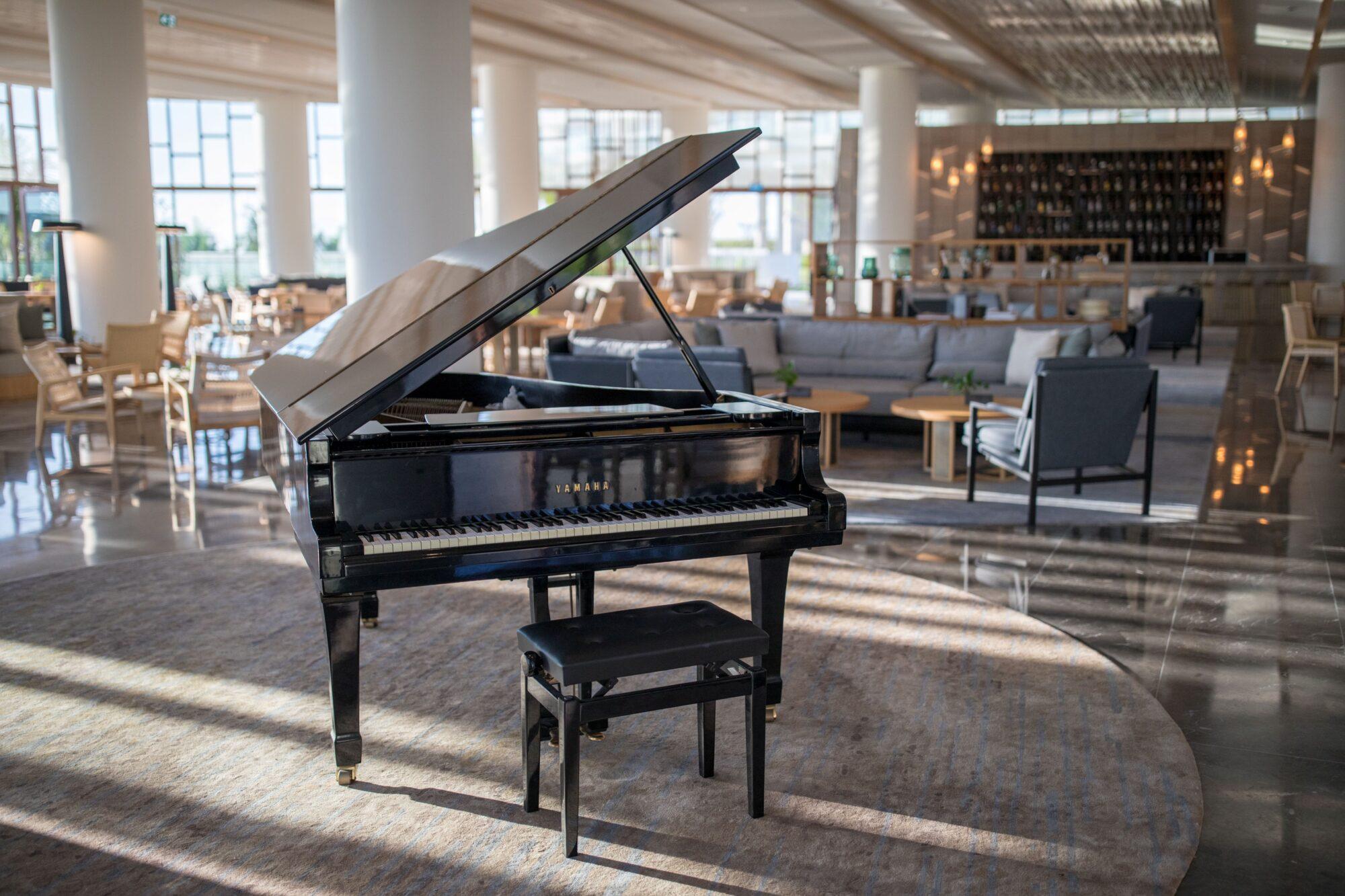
After the heat of the terrace, the Alma Lounge serves sandwiches and afternoon tea. Later, a sound bath at Le Spa, the Improve Sleep Quality session on Tuesday to Saturday from 17:30 to 18:30 for 350,000 VND (about 13 USD), suits an evening that began at six in the morning.

The Find Ultimate Serenity rate builds the evening in: a daily 60-minute body, back or shoulder treatment for each adult in the room, breakfast for two adults per bedroom, a cinema night with popcorn and a soft drink, and 15 percent off food and beverage, excluding Alma Mart and room service. Spa treatments must be reserved at least 24 hours ahead, so book them with the room, and the package cannot be combined with other promotions.
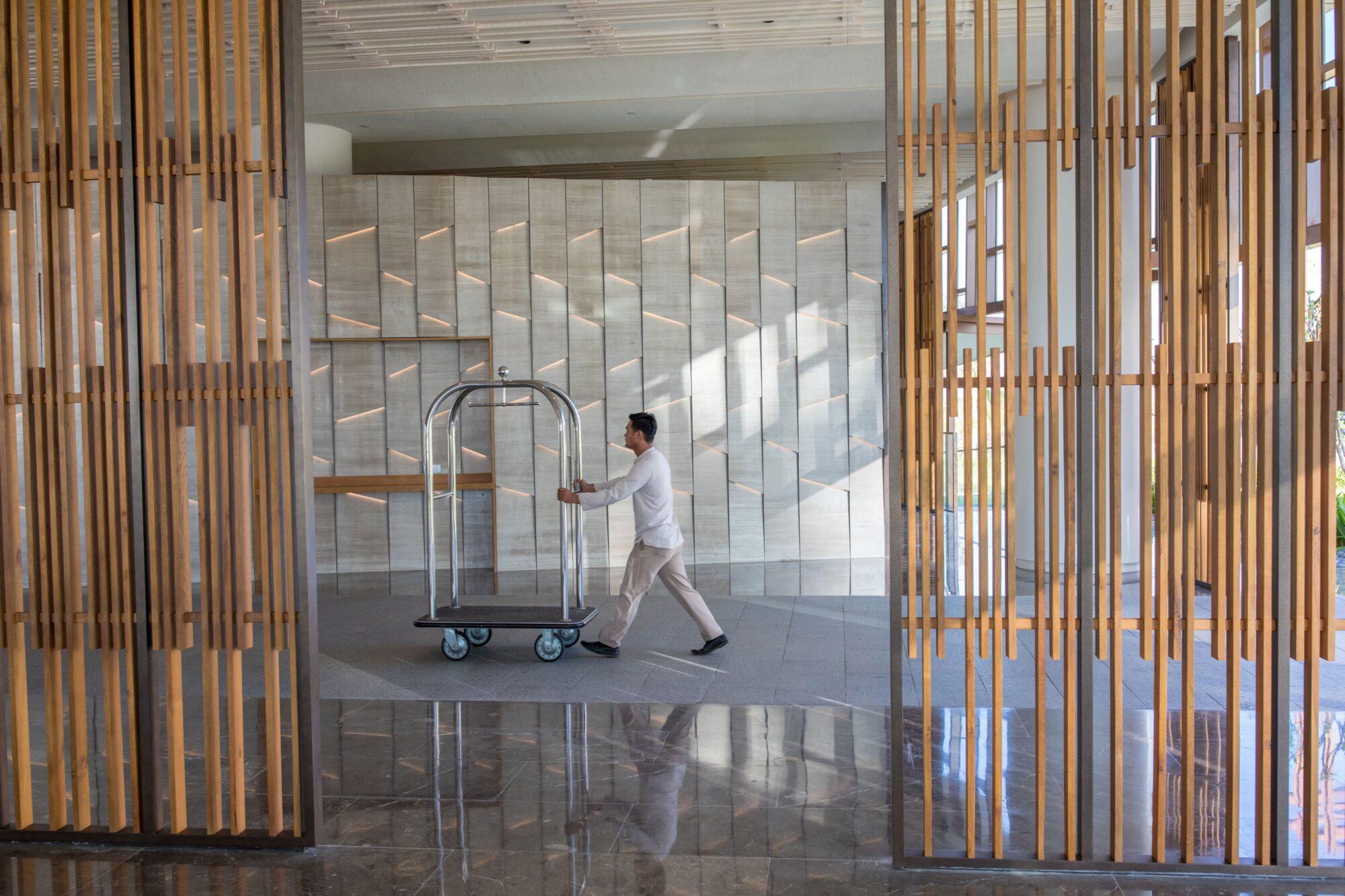
Rooms are ready from 14:00, and the 24-hour service centre is one call (dial 0) away on the room phone, so a late return from the city causes no trouble.
Conclusion
The Po Nagar Cham Towers repay an early start: a short climb, four mortarless brick towers, a goddess whose cult has lasted for more than a thousand years and a view across the bay. Cover shoulders and knees, remove shoes at each tower, go before 09:00 and combine the visit with Long Son Pagoda and the Stone Church for a complete morning.
From Alma Resort Cam Ranh the hill is about 45 to 50 minutes away, which leaves the whole morning for the towers. Visitors are back for lunch at the Alma Lounge and an afternoon swim, and the Zazen Travel heritage tour is available from the Promotions Desk.
Frequently Asked Questions
How much is the Po Nagar Cham Towers ticket?
The ticket costs 30,000 VND per person (about 1 USD), and children go free.
What time do the Po Nagar towers open?
The towers open daily from 06:00 to 18:00, closing at about 17:30 from October to December. Arrive by 17:00 so there is time to climb.
Who built Po Nagar, and for which goddess?
Cham builders raised the towers between the 8th and 13th centuries for Po Ina Nagar, the Mother of the Land. Guests at Alma Resort Cam Ranh can add the towers to a Zazen Travel heritage tour from the Promotions Desk.
What should you wear to Po Nagar?
Cover shoulders and knees, bring a light shawl or sarong and wear shoes that slip off, since shoes come off at each tower. Hats and sunglasses come off inside the shrines.
What pairs well with Po Nagar?
Long Son Pagoda is 9 minutes away by car, and the Stone Church is 7 minutes away, so both fit the same morning. From Alma Resort Cam Ranh the whole route is a half-day trip from the peninsula.